
“Deliver those that are drawn unto death, and those that are ready to be slain… if thou sayest, Behold, we knew it not; doth not he that pondereth the heart consider it?” — Proverbs 24:11–12 (KJV)
Nigeria, the Crosshairs, and America’s Moral Spine
By Judd Dunning — Newsmax author, radio host, and guest commentator, columnist — November 3, 2025
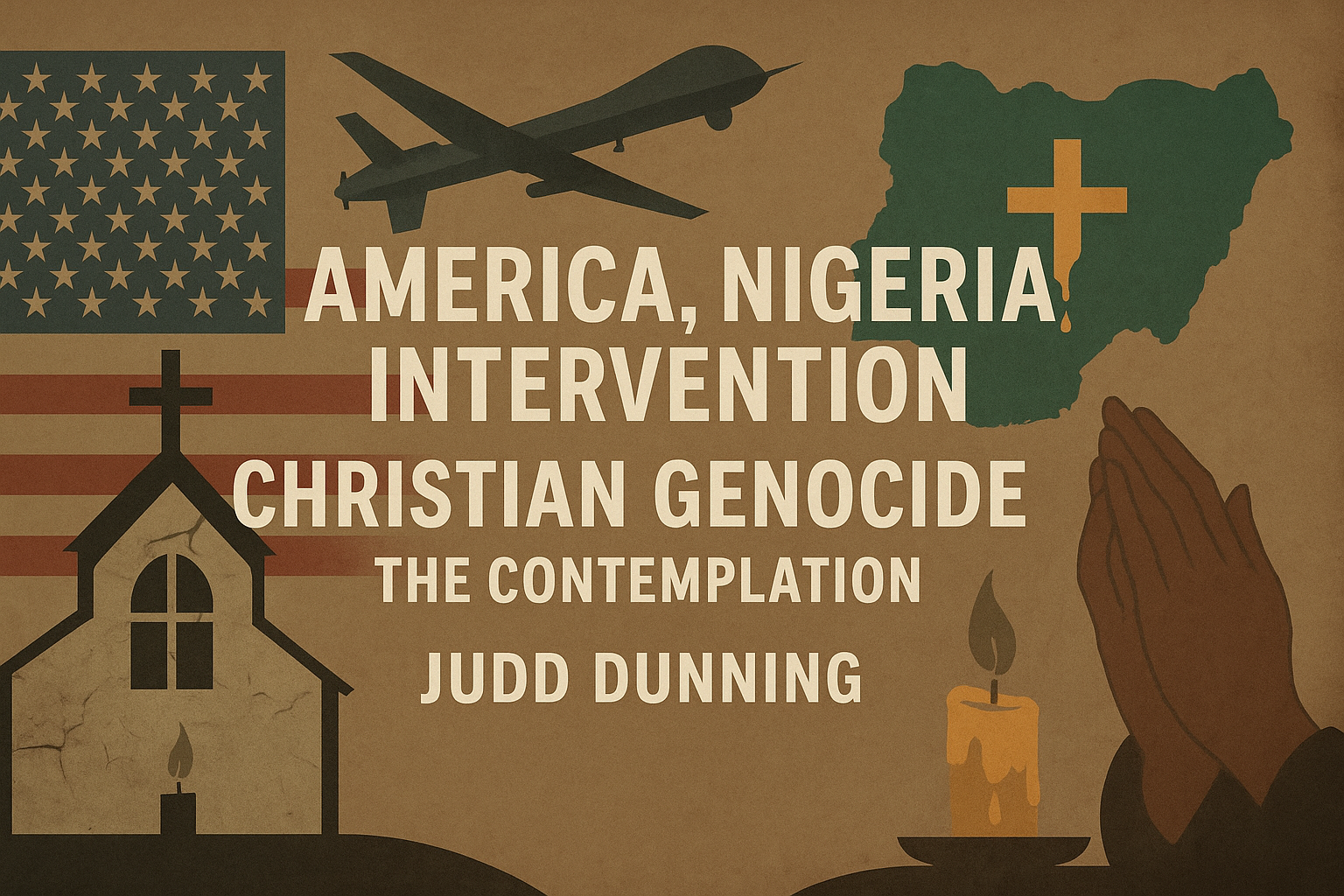
Pete Hegseth said what polite people dodge. President Trump added leverage: if Abuja won’t stop the killing, U.S. aid gets cut—and if asked, America can help stop the raids with real capability. Nigeria answered that violence touches multiple communities and any help must respect sovereignty. Both things can be true. The funerals are still real.
The record—no euphemisms
Nigeria remains the deadliest place on earth to be a Christian. Independent monitors consistently record roughly 3,000+ Christians killed and thousands abducted in a single year in Nigeria, with an outsized share of faith-related killings worldwide occurring there.
The exact numbers get debated; the pattern does not. The actors vary by region—Boko Haram and ISIS-West Africa in the northeast; heavily armed “bandit” and Fulani militia factions in the northwest and Middle Belt—but churches and Christian villages are repeatedly selected. Muslims also suffer brutally under jihadist and criminal violence, especially in the north.
Both truths can stand at once.
This isn’t just Nigeria. In the same seasons, Islamic State–aligned ADF massacred worshippers in DR Congo; Catholics were murdered at Mass in Burkina Faso; Pakistan’s blasphemy mobs still burn and lynch; India’s Manipur saw mass displacement and hundreds of churches destroyed. The global Church bleeds on multiple fronts. Nigeria is the center of gravity.
Across December 24–25, 2023, coordinated raids in Plateau State killed roughly 140–200 villagers across 17–20 communities—mass attacks, slow response, and almost no accountability afterward.
U.S. policy ground is shifting. The Country of Particular Concern drumbeat is back. On November 3, 2025, the United States formally designated Nigeria a Country of Particular Concern—unlocking targeted sanctions and the ability to tie security aid to measurable outcomes like prosecutions and faster response times.
If we pair that leverage with a measurable plan, it can matter. Treat Nigeria as indispensable; treat civilians as sacred; treat results as the only scoreboard.
Strength—with standards
Most of us Americans genuinely support decisive, lawful defense (especially to protect innocent people being slaughtered)—including drones—but, this is always going to be best under Nigerian authority and classic just-war guardrails: competent authority, just cause, right intention, last resort, proportionality, discrimination, and a real chance of success.
In practice that means: positive ID; pattern-of-life checks; abort on doubt; and transparent civilian-harm reviews to both legislatures. The aim is not theatrics. The aim is fewer funerals.
We also have a fresh cautionary precedent: publicly acknowledged airstrikes on suspected narco “go-fast” boats at sea. Supporters say deterrence; critics say legality and ID. The lesson for Nigeria support is simple—precision and oversight are non-negotiable.
Here’s first a plan that actually lowers the body count
1. Make CPC bite. Tie slices of U.S. security aid to auditable outcomes: faster response to village alarms, named prosecutions, and verifiable disarmament in hot LGAs.
2. Sanction the ecosystem. Global Magnitsky/visa bans for planners, funders, quartermasters, and officials who obstruct justice; cut the guns/fuel/finance lines.
3. Early warning + rapid response. LoRa/SMS beacons that ping police/army and neighboring parishes at once; vetted community defense under state command; night-capable mobility where the raids actually happen.
4. Precision under law. If Abuja requests it, joint ISR and precision black-op and drone strikes on repeat raiders and command nodes, with public after-action reviews. Eliminate the threats with laser accuracy and intel.
5. Partner hard, don’t humiliate. No blank checks; no public dunking for clicks. Quiet pressure, clear benchmarks, visible wins.
Why it matters to America
If West Africa spirals, we’ll pay anyway—in refugees, terror finance, and another region handed to ISIS franchises. Strategically, morally, spiritually, Nigeria matters.
Conscience, Strength and Peace

It’s enraging—these killings.
Yes, whenever we can, we must stop, eliminate evil, and rescue or free the oppressed. Yes, we must punish those who are true barbarians, to our Christian brothers and sisters being denied life for their sacred religious beliefs. The stupidity and horror of it aside, yet we must still strive to act lawfully whenever possible as our code.
Now that we have stated these noble words above, we confront the American tension: honoring sovereignty and practicing restraint even while people are being slaughtered and justice is urgently needed. In the fight against evil, hypocrisy can creep in after long policy debates.
America is far from perfect; yet in the spirit of moral absolutes, we still know right from wrong—and, more often than not, we stand for the good.
Sovereignty vs. Evil — the American Argument
America’s best statesmen have always wrestled here. Washington warned against foreign entanglements; Monroe drew a hard hemispheric line; Roosevelt’s Corollary said we’d intervene to prevent chaos at our doorstep.
The Caroline test (1837) set the bar for striking first: necessity “instant, overwhelming,” and any force proportionate. Wilson took us into WWI to “make the world safe for democracy,” then the country recoiled—until FDR, who refused fantasy neutrality and became the arsenal of democracy before joining the fight against genocidal evil.
Truman drew the line with a doctrine: support free peoples resisting subjugation. Reagan named the evil empire and used force in Grenada with a liberation rationale. Bush 41 built a UN-backed coalition to restore Kuwaiti sovereignty—power used for sovereignty, not against it. Clinton tested humanitarian intervention in Kosovo without a UN veto. Bush 43 advanced preemption in Iraq—moral intention, deeply contested means. Obama invoked Responsibility to Protect in Libya—limited aims, messy aftermath. Through it all runs the same American tension: moral duty vs. the law of nations.
Great men should struggle—then decide. The guardrails are ancient and American: just cause, competent authority, last resort, discrimination, proportionality, and a credible chance of success. When those are met—ideally with host-nation consent or mandate—we act so fewer innocents die, not to perform virtue. That is how a republic uses force without becoming what it fights.
Are we acting under legitimate authority, for defense of the innocent, with an intention to end the violence? Will this plan reduce funerals? If not, why would we fight this way?
Are our means discriminating, proportionate, accountable—and abort-capable when doubt enters the room? Are we pairing force with law—arrests, prosecutions, sanctions—so the cycle actually breaks? Do we have the courage to be fast and the humility to be measured?
Think First. Pray First. Then Act.
Think—about authority, cause, intention, limits, civilians, and whether the plan will actually protect the innocent.
Pray—for clarity without hatred, restraint without delay, courage without pride, mercy without naïveté.
Act—when lesser means fail; then act lawfully, proportionately, and discriminately—to stop the killing, not to posture.
In classic conservative contemplation—here are a few guideposts of wisdom to consider.
Through the philosophy of justice and just war…
“Love will constrain from killing, except in situations of tragic necessity… even then it will permit killing.” — Nigel Biggar.
“Aggression is the name we give to the crime of war.” — Michael Walzer.
“We take, and must continue to take, morally hazardous actions to preserve our civilization.” — Reinhold Niebuhr.
“So the authority of a sovereign is necessary for a just war.” — James Turner Johnson.
“If one abides by just war restraints… that is the burden of the just warrior.” — Jean Bethke Elshtain.
Through the philosophy of Scripture
“…(A leader) he beareth not the sword in vain… a revenger to execute wrath upon him that doeth evil.” — Romans 13:4.
“Deliver them that are drawn unto death… shall not he render to every man according to his works?” — Proverbs 24:11–12.
“If it be possible… live peaceably with all men… Vengeance is mine; I will repay, saith the Lord.” — Romans 12:18–19.
“Defend the poor and fatherless… Deliver the poor and needy; rid them out of the hand of the wicked.” — Psalm 82:3–4.
“Learn to do well; seek judgment, relieve the oppressed, judge the fatherless, plead for the widow.” — Isaiah 1:17.
So, what’s actually next? Pete Hegseth said it clearly.
We must always first strive to be angels of our highest nature in our civil society. We must think.
But what happens next we already know: we follow the playbook. The United States asks—formally—first.
Corrupt officials refuse. We pause, reflect, and pray. After making every effort to honor their sovereignty—ideally through quiet back-channel diplomacy—if it fails, limited covert operations and precise drone strikes remove the worst perpetrators.
Because evil is evil. We reluctantly go in, accomplish the mission, and leave—like ghosts.
Let them fear these harsh consequences. The persecution and murder of Christians must end. America is watching—and coming. We must—it’s who we are.


ABOUT JUDD DUNNING
Follow Judd on X (Twitter), visit JuddDunning.com, and read more of his latest work on Newsmax.Judd Dunning is the former host of Unapologetic with Judd Dunning on KABC AM790, a Newsmax Insider columnist, and the author of 13½ Reasons Why NOT to Be a Liberal.Over the years, Judd has created and hosted multiple political media projects, blending wit, Judeo-Christian values, and hard constitutional truth. His work champions free speech, American exceptionalism, and the fight against Marxist ideology and elite corruption.
Look for Judd’s forthcoming book:13½ Reasons to Love America — Why She’s Been the Very Best for 250 YearsHard facts on America’s anniversary of greatness, how Trump helped revive her, and why we must keep exposing and removing anyone or anything that seeks to dim her light.
Leave a Reply