By Judd Dunning
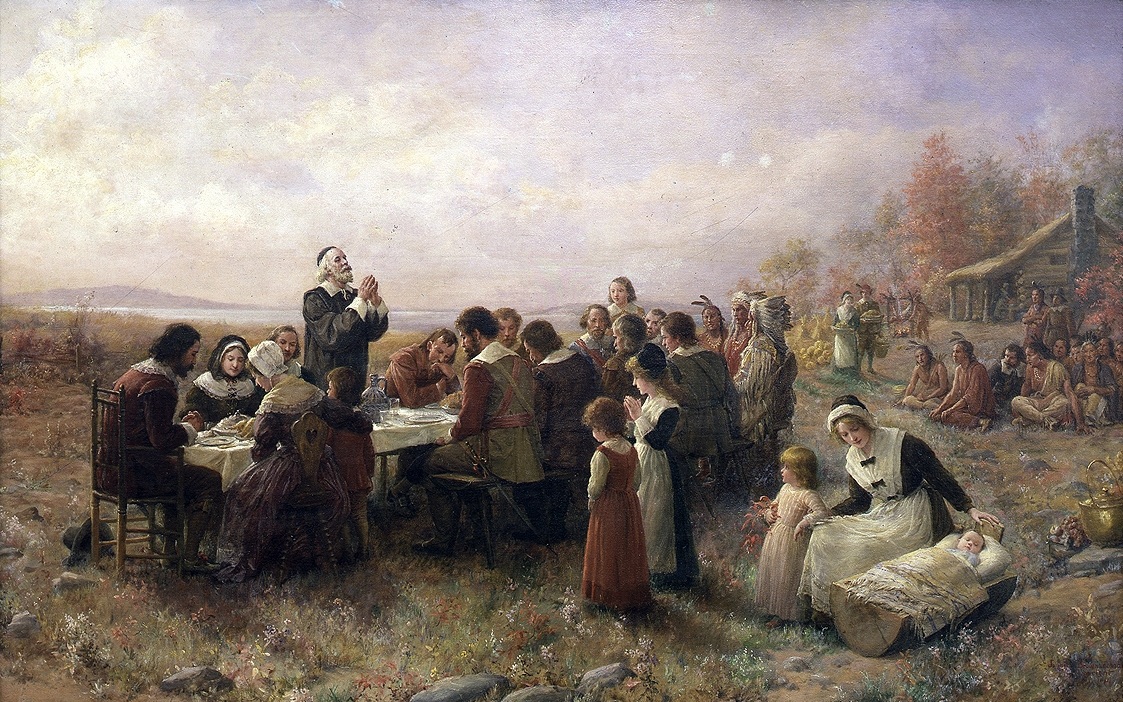
Rare. Valuable. Precious. Blessed. Much like our remarkable constitutional republic—our first Thanksgiving, now a symbol of American gratitude—almost never happened.
Gratitude is one of the highest states; it creates more goodness, more prosperity, more patriotism, more unity than almost any other emotion. Gratitude is a bedrock of our American way. We are a positive people. We focus on the good and on the things we’re grateful for—because we know just how blessed we are.
For as Scripture reminds us, ‘Rejoice always, pray without ceasing, give thanks in all circumstances; for this is the will of God in Christ Jesus for you’ (1 Thess. 5:16–18).
And again, ‘Be anxious for nothing, but in everything by prayer and supplication, with thanksgiving… the peace of God will guard your hearts and minds through Christ Jesus’(Phil. 4:6–7).”.
By the winter of 1621, only 52 of the 102 Mayflower passengers were still alive. Of them, only four adult women survived to prepare the food for the harvest feast later that year. Families had been gutted. Children had buried parents. The living were so afraid of looking weak that they buried their dead at night so nearby tribes wouldn’t see how many were gone.
From any normal historical standpoint, this little colony should have disappeared.
Yet from that wreckage came a functioning settlement, a 50-year peace treaty, and a tradition of national gratitude that two later presidents would enshrine in the middle of our darkest hours. That, not the Hallmark imagery, is the miracle of Thanksgiving.
What They Were Really Running From
The people we call Pilgrims did not wake up one day and say, “Let’s go on an adventure.” They were religious dissidents in an era when the wrong convictions could cost you your job, your land, your freedom, or your life.
In England they were known as Separatists. They believed the Church of England, welded tightly to the state, was so compromised that it could not be reformed from within. They refused to attend state services. That single act of conscience exposed them to fines, harassment, imprisonment, and surveillance. Some of their pastors died in jail. Others held secret meetings in barns and back rooms, never sure when the authorities would break in.
They had seen what persecution looked like elsewhere. Their spiritual cousins, the French Huguenots, had already paid in blood. In 1572, during the St. Bartholomew’s Day Massacre, somewhere between 5,000 and 20,000 Huguenots were murdered in Paris and across France—dragged from homes, hunted in the streets, thrown into the Seine. Over decades, tens of thousands more were killed, driven from their professions, or forced to convert.
Some Huguenots tried to escape to the New World—like the Protestant colony at Fort Caroline in present-day Florida—only to be wiped out by Spanish forces who boasted they had killed them “not as Frenchmen, but as Lutherans.”
The Pilgrims knew this story. They were another chapter in the same book: ordinary people willing to risk everything rather than bend their conscience to the state.
They first fled to Leiden in the Netherlands, where they found more religious tolerance but little stability. They worked brutal, low-wage jobs in a foreign language. They watched their children drift into Dutch culture. War clouds were once again gathering over Europe. Their leaders finally concluded that the only way to preserve their faith, families, and identity was to leave Europe altogether—cross an ocean and start from scratch.
In their minds, it wasn’t reckless.
It was, tragically, the least dangerous option left.

The Voyage: Sixty-Six Days in the Dark
We often talk about the Mayflower voyage as “hard.” That’s polite. The reality is that it was an almost unthinkable ordeal.
The Mayflower was a merchant cargo ship, not a passenger vessel. More than 100 passengers were crammed into a low, foul compartment designed for barrels, not families. For 66 days, they lived in near-darkness, in air thick with human waste and seasickness. Storms battered the ship so violently that at one point a main structural beam cracked.
They debated turning back.
Instead, using a large iron screw—cargo from a printing press—they braced the beam and pushed on.
People vomited, prayed, argued, and tried to breathe in a space where most adults couldn’t even stand up straight. A man was thrown overboard into the freezing Atlantic and survived only because he managed to grab a trailing rope. By the time land finally appeared, two passengers were dead, many were seriously ill, and all were exhausted.
They were also in the wrong place. Aiming for Virginia, they had been blown hundreds of miles north. They stepped ashore in New England in November, with winter coming on, bodies weakened, provisions low, and no backup plan.
The real suffering was still ahead.
Graveyard Corn and a Dying Winter
Desperation led quickly to moral gray zones. As they explored Cape Cod looking for food, Pilgrim scouting parties found buried caches of corn carefully stored by local Wampanoag families. Starving and ignorant of local customs, they dug up the corn and took it. Only later did they realize that some of those stores were tied to graveyards and sacred sites.
It’s an uncomfortable fact: the founders at the heart of our Thanksgiving story began their New World experience accidentally stealing corn from Indian burial grounds.
To their credit, once real contact with the Wampanoag was established and trade began, they tried to repay what they had taken. But the picture is honest: these were not flawless heroes. They were desperate, fallible human beings trying to stay alive in a world they did not understand.
Then the winter hit.
Disease, exposure, and malnutrition swept through the settlement. In roughly three months, half the colony died. At times, rations dropped to five kernels of corn per person. Bradford wrote of the living “staggering” from weakness. Children watched one or both parents die. Graves multiplied.
And yet, in the midst of this, they built rough houses, cared for orphans, and somehow kept the community from collapsing into chaos.
From a purely statistical standpoint, Plymouth should have ended as a failed experiment and a forgotten footnote.
The Quiet Economic Revolution
Alongside the physical crisis, there was a slower, structural disaster: the economic system itself.
Under pressure from their English investors, the Pilgrims initially operated with communal land and shared production. The idea sounded noble. In practice, it produced low effort and lower yields. Some people worked hard, others didn’t—but everyone received the same share. Bradford observed growing resentment, laziness, and famine-level scarcity.
In 1623, he made a quiet but revolutionary decision: he reassigned land into private family plots and allowed people to keep and trade the fruits of their own labor.
The results were immediate and dramatic. Productivity surged. People planted more, tended their fields more carefully, and carried their own weight. Food supplies increased. The colony stabilized.
This wasn’t a think-tank experiment. It was survival. But the lesson was clear: when they shifted from imposed collectivism to personal responsibility and ownership, the colony began to live instead of slowly dying.
Part of the Thanksgiving miracle is not just that they prayed; it’s that they course-corrected fast enough to stay alive.
An Alliance That Shouldn’t Have Worked
Then came the political miracle.
The Wampanoag Confederacy under Chief Massasoit had been devastated by disease, very likely brought by earlier European contact. Some areas may have lost up to 90% of their population. The Wampanoag also faced pressure from the rival Narragansett. The Pilgrims, weak and desperate, were potential liabilities or potential allies.
In most of human history, this setup ends in conquest or annihilation.
Instead, through careful diplomacy and the help of translators like Tisquantum (Squanto)—himself a man who had been kidnapped, enslaved in Europe, miraculously freed, and returned—Massasoit and the Pilgrims forged a mutual defense and trade treaty.
Remarkably, it held for more than 50 years.
For half a century, in a violent era, these two very different peoples managed a real, if fragile, peace. They traded. They learned from each other. They navigated threats together.
The three-day harvest celebration we remember as the first Thanksgiving was a public recognition of that peace and that harvest: Wampanoag and Pilgrims eating, talking, and even competing together—not as conqueror and conquered, but as uneasy allies.
In world history, that is not normal.
That is exceptional.

Gratitude Before the Ending
When they gathered to give thanks, the Pilgrims were not standing on the far side of a resolved story. Their peace was new. Their food supply was still fragile. Their legal status with England was uncertain. Their dead were freshly buried. They had no guarantee that Plymouth would survive another decade.
They stopped anyway. They prayed anyway. They thanked God anyway.
That is the original spiritual DNA of Thanksgiving: gratitude in the middle of the storm, not at the end of it.
Later, George Washington declared a national day of thanksgiving in 1789, when the new Constitution was only a year old, the federal government was controversial, and the young republic was far from secure. He called the nation to a day of public thanks and prayer—not because everything was stable, but because he knew that a free people must remember where their blessings come from.
In 1863, Abraham Lincoln turned Thanksgiving into an annual national holiday—in the middle of the Civil War, when the country was literally tearing itself apart and its survival was in doubt. Lincoln did not wait for victory. He asked Americans to give thanks even as they buried their dead.
Both presidents reached back to Plymouth because they understood the same principle: a people that remembers its blessings survives its crises.
How Thanksgiving Became a National Holiday
For a long time, “days of thanksgiving” were regional and irregular. Different colonies—and later, states—called days of fasting or gratitude at different times, usually in response to war, drought, deliverance, or some perceived merciful turning point. These were serious civic and spiritual events, not long weekends.
Washington’s 1789 proclamation was the first national version, but it still wasn’t a fixed holiday. That took the persistence of a remarkable woman, Sarah Josepha Hale, editor of Godey’s Lady’s Book, who spent decades lobbying presidents to make Thanksgiving a single, unifying national observance. She wrote to five presidents. Four did not act.
Lincoln did. In 1863, at perhaps the lowest emotional point in American history, he issued a proclamation establishing a recurring national Thanksgiving Day on the last Thursday of November. He framed it as a time to look past the immediate bloodshed and acknowledge the “gracious gifts” of God that had not been withdrawn.
Gratitude became a kind of civic glue—a way to remind a fractured people of the good that still existed beneath the horror of war.
Later, in 1941, with another global conflict underway, Congress and President Franklin D. Roosevelt formalized Thanksgiving as a permanent federal holiday, fixing it on the fourth Thursday of November. Across our most dangerous eras, the pattern is the same: when America faces existential tests, her leaders reach back to a story of persecuted settlers who chose gratitude before they ever saw how the story would turn out.

A Beautiful Holiday We’ve Almost Forgotten
Ironically, as Thanksgiving became more secure on the calendar, its deeper meaning began to thin out. We kept the meal, the football, the travel, and the four-day weekend. But the idea that this is supposed to be a national act of gratitude, humility, memory, and moral clarity faded into the background.
Thanksgiving is now often treated as a warm-up for shopping or a brief cease-fire between social media arguments. We flatten it into décor. We forget that it was born out of persecution, storms, graveyard corn, starvation, economic repentance, unlikely peace, and gratitude long before deliverance. We forget that Washington used it to steady a nervous newborn republic, and Lincoln used it to help a bloodied nation remember itself.
And that is exactly why it is still such a beautiful holiday.
At our best, Americans don’t imagine we are better than other peoples. We know we have been unusually fortunate. We were born into a legal and political inheritance that reaches back to the Magna Carta, to English common law, to French political thought about liberty and the separation of powers, to natural-law ideas—shaped by Christian theology and classical, even Neoplatonic, philosophy—that insist human beings have inherent dignity and rights. We happened to occupy a vast, resource-rich continent, buffered by two oceans, at a moment in history when those ideas about law and liberty could actually take root. That combination of ideas, timing, geography, and resources is not something we earned. It is not proof that we are better. It is, if we are honest, evidence that we have been blessed far beyond our merit. A healthy Thanksgiving patriotism doesn’t brag about America; it bows its head in gratitude that, by God’s grace, we get to live in one of the most legally free and materially blessed nations in history—and it asks what we are going to do, humbly and responsibly, with that gift.
It is one of the few traditions left in American civic life that asks nothing from you except honesty: look at what you have survived, look at what your country has survived, look at the blessings that have carried you farther than you deserve, and say so out loud.

Thanksgiving reminds us that our story did not begin with perfection. It began with persecuted families crossing a deadly ocean, nearly dying on arrival, making mistakes, correcting them, forging peace where history predicted war, and choosing gratitude with no guarantee that things would improve.
Gratitude was the Pilgrims’ anchor before deliverance, Washington’s stabilizer in a divided republic, and Lincoln’s medicine in a nation at war with itself.
When we forget that, we lose more than a holiday. We lose a spiritual survival skill.
When we remember it, we recover something powerful: the knowledge that gratitude is not the reward of a good year; it is the discipline that carries a people through the bad ones.
So when you sit down this Thanksgiving and someone waves off the “Pilgrim myth,” don’t fight. Just remember the real story you’re standing in: the persecuted dissidents, the lethal voyage, the graveyard corn, the dying winter, the economic pivot, the improbable treaty, the presidents who reached back to that moment to heal a fractured country.
The miracle of Thanksgiving is not that they had a feast.
The miracle is that, after everything they had endured and everything they still didn’t know, they were still there to give thanks—and that their stubborn act of gratitude still has the power to steady a nation that always benefits by remembering who it truly is.
ABOUT THE AUTHOR
Truly American, Judd Dunning’s family first came to America in 1770 to fight the British and then on both sides of the Civil War. The other side of his family fled the deadly Pogroms in Poland to arrive in Massachusetts in 1906. Later, after the Spanish-American War as developers and cattle ranchers in Cuba, when Castro seized their property in 1959, they fled back to America.
He is the President and Principal of DWG Capital Partners, a national industrial private equity platform, and a former co-founding team member of Newmark Capital Markets division in West Los Angeles.
Judd is also a Newsmax columnist, a frequent radio and TV guest, and the author of a prior best-selling Humanix book, as well as his forthcoming new book, titled “13½ Reasons to Love America”. Judd is also a free-market capitalist, a entrepreneur and an unapologetic lover of the American experiment, recognizing its risks, resilience, and enduring promise.

Leave a Reply