

By Judd Dunning — Author | Newsmax Writer | TV & Radio Commentator
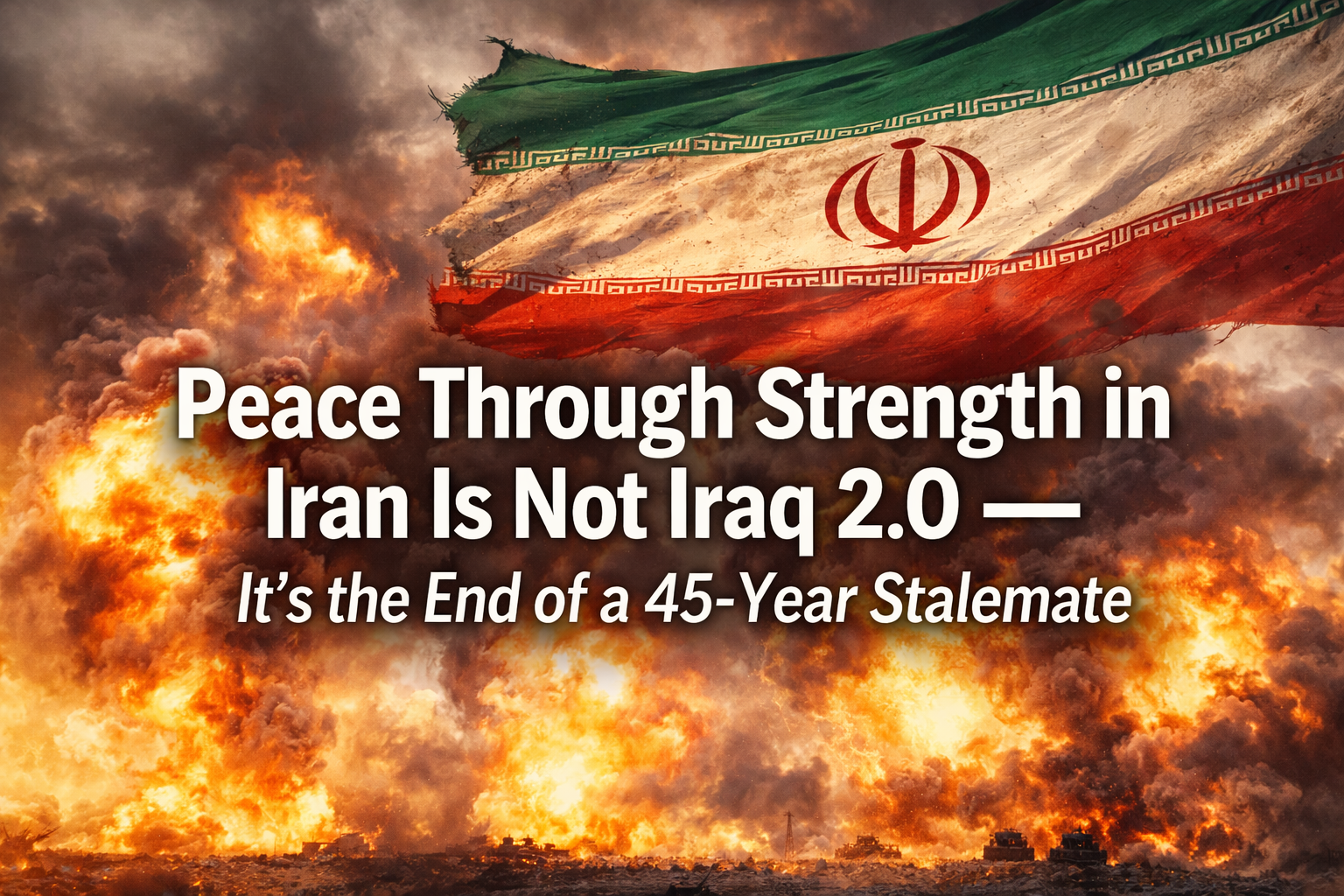
For twenty years Americans have lived under the ghost of Iraq. Every foreign-policy decision, every strike, every assertion of deterrence is instantly measured against that memory: “another forever war.” So when President Donald J. Trump announced major combat operations against Iran — Operation Epic Fury — the political class reached for the familiar script before the smoke even cleared: regime change, occupation, Iraq 2.0.
But history does not repeat itself when strategy changes. And this time, the strategy is the opposite of Iraq.
Iraq was a war of transformation. This is a war of prevention. Iraq sought to build a democracy from the ground up — a noble idea executed with unlimited exposure and undefined exit conditions. America tried to reshape a society and, in the process, became responsible for it. Operation Epic Fury is different. Its purpose is limited, measurable, and strategic: deny a nuclear-threshold regime the protection of ambiguity. When President Trump told the Iranian people to “take over your government,” critics heard invasion. Strategists heard something else: the United States will not occupy you — but it will no longer shield rulers who threaten the world. Vice President J.D. Vance reinforced the same point: there is “no chance” of a years-long Middle East war. That is not bluster. That is doctrine. Peace through strength only works when strength has boundaries and consequences.
History provides precedent. In 1986, after Libyan-backed terrorism struck American servicemen in Berlin, President Ronald Reagan launched a limited strike against Muammar Gaddafi’s command infrastructure. Critics predicted a spiral into Middle Eastern war. Instead, Libyan-state terrorism dropped dramatically for years. Deterrence, once demonstrated, altered behavior without occupation. The lesson was simple: decisive but limited force can shorten conflict, not expand it.
The United States confronted Iran directly in 1988 during Operation Praying Mantis after Iranian forces mined international shipping lanes and damaged a U.S. warship. American naval forces destroyed much of Iran’s navy in a single day. Tehran did not escalate. Months later it accepted a ceasefire in its regional war. Decisive force shortened the conflict rather than widening it.
More recently, in 2017, the United States struck Syria’s Shayrat airbase after chemical weapons were used against civilians. No invasion followed, yet the regime’s behavior changed and chemical attacks sharply declined for a significant period. The objective again was not conquest but restoring a boundary.
In 2020 the strike that killed IRGC commander Qassem Soleimani was predicted to ignite regional war. Instead escalation peaked quickly and receded. Militia activity temporarily dropped and deterrence was re-established.
Operation Epic Fury follows the same doctrine — targeted punishment to restore calculation.
Since 1979 the Islamic Republic perfected a method of warfare built on calibrated escalation: attack indirectly, operate through proxies, and remain just below retaliation thresholds. The record is long and specific. The 1979 hostage crisis held American diplomats for 444 days. Hezbollah bombings in Beirut killed U.S. Marines in 1983. The 1996 Khobar Towers bombing killed U.S. personnel. Militias armed by Tehran killed hundreds of American soldiers in Iraq after 2003. The regime funded Hamas and Islamic Jihad rocket campaigns against civilians. It armed the Houthis who struck international shipping lanes and Gulf infrastructure. Assassination plots reached into Europe and even U.S. soil. Meanwhile the nuclear program advanced in calibrated increments — enrich, deny, negotiate, repeat.
Operation Epic Fury breaks that cycle. It does not seek land. It does not seek occupation. It seeks to remove the immunity shield around strategic aggression. For the first time in decades, the price of escalation attaches to decision-makers — not just militias. That is not regime change. That is restoring deterrence.
Iran’s nuclear authority is not civilian — it rests with the SUPREME LEADER and the Islamic Revolutionary Guard Corps (IRGC). The IRGC runs the missile program and commands proxy forces (Hezbollah, Iraqi militias, Assad-aligned units, Houthis). State rhetoric has long included chants and official statements like “Death to America” and “Death to Israel,” framing those countries as ideological enemies. In that clerical-military chain, any strategic weapon would be controlled by a hardline, ideologically driven command structure — not by elected officials.
At the same time Tehran is building insulation from sanctions by expanding non-dollar energy trade with China and deepening military-economic ties with Russia — RMB and ruble settlements, currency swaps, and shadow-fleet shipping. The effect is not replacing the dollar globally, but weakening U.S. pressure in specific corridors. In that framework nuclear leverage, proxy warfare, and financial bypass operate together — military deterrence and economic deterrence now overlap.
The scope of Iran’s network matters because it explains both the reach of Tehran’s options and the necessity of targeted response. Iran’s best-known clients and proxies include Hezbollah in Lebanon, Hamas and Palestinian Islamic Jihad in Gaza, Iranian-backed Shiite militias in Iraq, militia elements embedded with the Assad regime in Syria, and the Houthis in Yemen. These groups deploy rockets, drones, roadside bombs, and maritime attacks. Analysts call it the “axis of resistance,” a distributed military structure allowing Iran to project force globally while avoiding direct retaliation.
Those proxies have produced concrete threats: missile arsenals on Israel’s borders, rocket campaigns from Gaza, militia strikes on coalition bases, and Red Sea shipping disruptions. Iran provides funding, weapons, training, and coordination — multiplying asymmetric warfare across regions.
If Iran’s nuclear program is included in that calculus, deterrence becomes urgent. International monitoring reports show enrichment levels approaching weapons-usable thresholds and expanded advanced centrifuge activity. Such capability drastically shortens breakout timelines if weaponization were chosen. A regime directing proxy warfare while approaching nuclear capacity changes the strategic equation entirely.
To understand why Iran sits at the center of Middle East instability, Americans have to remember what Iran was — and what it became.
Modern geopolitics in Iran did not begin in 1979. In 1908 the Anglo-Persian oil concession tied the nation’s resources to foreign power structures. The 1953 Mossadegh crisis reinforced the link between energy and sovereignty. The 1979 revolution replaced monarchy with ideology but preserved leverage through instability.
Yet the society it replaced was not backward. In the 1960s and 1970s Iran’s urban centers resembled Western societies. Women attended universities. Tehran hosted a thriving artistic and scientific community. Persian civilization — birthplace of algebra and one of the oldest continuous cultures — produced a modern middle class engaged with the world. Many emigrated after 1979 and live in the United States today, describing the divide between people and regime.
That governing order has committed documented repression. Amnesty International recorded hundreds of executions annually, including at least 853 in 2023. The protests following Mahsa Jina Amini’s death produced mass arrests, torture allegations, and hundreds — by some counts thousands — killed in crackdowns. Women face compulsory veiling enforcement and lethal custody incidents. LGBTQ individuals face criminal penalties including capital punishment under certain statutes. Journalists, students, minorities, and dissidents face detention and intimidation documented by international investigations.
The conflict therefore is not simply nation versus nation but regime behavior versus stability.
Critics call this escalation. Strategically, it is closure. The United States is not expanding war; it is narrowing it — targeting coordination rather than fighting militias indefinitely across multiple countries. A decisive action now may prevent dispersed conflict later.
The United States has faced a moment like this before. During the Arab Spring Washington hesitated — unsure whether popular uprisings would produce stability or chaos — and the vacuum was often filled by stronger ideological actors rather than reformist ones. The lesson was not that change was impossible, but that passivity surrendered influence to whoever was most organized.
If the regime’s top layer collapses the most likely immediate outcome is an IRGC-led consolidation: the Guard is the best-organized coercive instrument and can impose order quickly while shaping succession behind a clerical veneer (40–60%). A managed, clergy-backed council that preserves the constitution is the second plausible outcome (20–30%). Less likely in the short term but still possible are fragmentation into regional power centers (10–25%) or a negotiated technocratic caretaker (5–15%). A genuine mass-led democratic transition remains the hardest path — possible over time if security institutions fragment and civic coalitions organize (1–8%). Watch IRGC cohesion, Assembly of Experts moves, defections in the security forces, and organized general strikes — those signals will tell you which scenario is unfolding.
That is the paradox of peace through strength: refusing to act invites endless small wars; acting decisively can prevent large ones. The policy choice facing Washington is stark: continue with containment without consequence — endless rocket attacks, militia strikes, shipping disruptions and no decisive resolution — or accept a defined deterrence event: short-term shock, clear red lines, and long-term behavioral change. For forty-five years Washington chose the first model. Operation Epic Fury chooses the second — not because war is desired, but because perpetual half-war is worse.
Peace is not the absence of force. Peace is the absence of incentive for violence. If leadership can provoke without consequence, violence persists. If leadership risks survival when provoking, calculation changes. The objective is not conquest. It is to make escalation irrational. That is why the Founders placed defense power in civilian hands — not to seek war, but to prevent future wars by credible resolve in the present one.
Success here will not be Tehran falling tomorrow. Success will be quieter: fewer proxy attacks, open shipping lanes, nuclear rollback pressure, and regional normalization continuing. Success is a Middle East where stability becomes more profitable than confrontation.
Finally, credit where it is due: by acting decisively, President Trump relieved the political shackles that often force leaders to pander rather than govern. He accepted the short-term political heat that accompanies hard decisions instead of deferring to the next weak administration that might have backed away. That resolve — unpopular today perhaps, but necessary tomorrow — may spare countless lives by preventing a larger, protracted conflagration. In a region where hesitation has long been a strategic currency, decisive action can change the calculus and buy a measure of peace.
For two decades Americans were told every use of force leads to occupation. But history shows something else: indecision leads to repetition. Operation Epic Fury is not Iraq 2.0. It is the attempt to end the cycle that Iraq never could — the permanent gray war that never quite began and never quite ended. Peace through strength does not mean celebrating war. It means refusing to subsidize instability forever. Sometimes the most restrained policy is the one that finally draws a line.
ABOUT THE AUTHOR Judd is a Newsmax columnist, a frequent radio and TV guest, and the author of a prior best-selling Humanix book, as well as his forthcoming new book, titled “13½ Reasons to Love America”. Judd is also a free-market capitalist, an entrepreneur and an unapologetic lover of the American experiment, recognizing its risks, resilience, and enduring promise — and a lover of all wisdom-seeking religions and all the great philosophers.

Sources: International Atomic Energy Agency — Iran Verification Reports (2024–2025) Wilson Center — analysis of Iran’s proxy network Amnesty International — Iran execution and human-rights reporting (2023–2024) United Nations Human Rights Council — Iran fact-finding mission reports (2022–2024) Britannica / Naval History / NHHC — Operation Praying Mantis (1988) and 1986 Libya strikes Reuters / Financial Times / Carnegie Endowment — reporting on succession, de-dollarization, and Iran’s export routes
Leave a Reply