By Judd Dunning
Newsmax Insider and Guest TV and Radio Commentator
The clearest way to judge President Trump’s second term is not through corporate media panic, hyper-metastasized outrage, or popularity polls battered by the Iran conflict, gasoline shocks, and the difficult work of repair. Doing the right thing is rarely easy or immediately popular. Fixing a damaged country never polls as well as managing its decline.
When you look at the facts, a far different story emerges. There are so many significant developments occurring at once that they are becoming difficult to track. Several weeks later, the same basic reality remains: America has not collapsed, markets have not surrendered, employers are still hiring, and capital continues moving toward the industries that define national strength.
This is not only an economic story. It is an accountability story. It is a credibility story. It is the story of a country beginning to repair itself after years of institutional failure, public deception, and political arrogance.
THE WINNING ECONOMIC STORY NOBODY WANTS TO TALK ABOUT
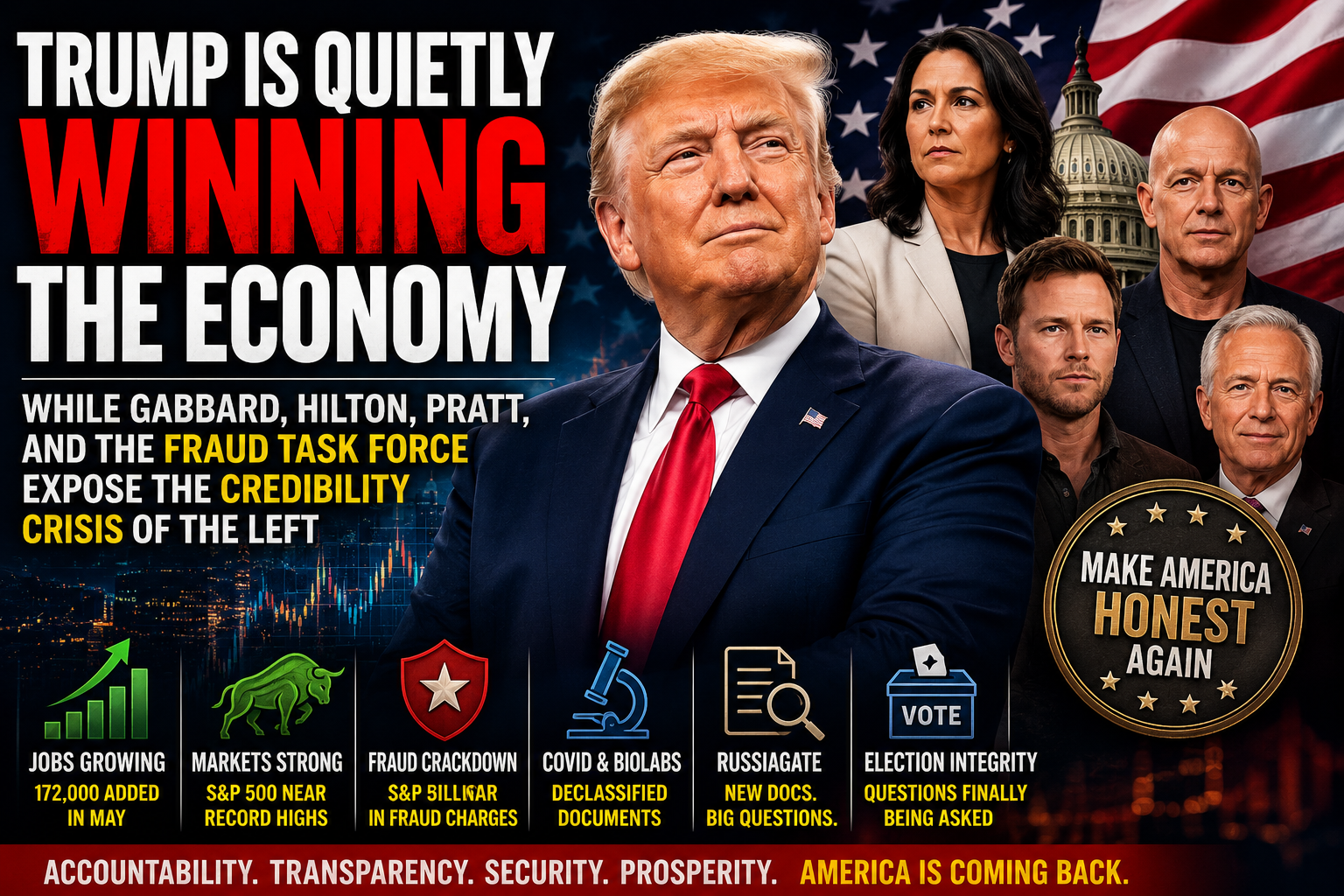
America added approximately 172,000 jobs in May while unemployment held near 4.3 percent. The S&P 500 remains near record highs. The Nasdaq continues climbing. Corporate earnings remain strong. Consumers are still spending. Manufacturing investment continues. Artificial intelligence, energy, defense, infrastructure, data centers, and industrial expansion continue attracting serious capital.
This is not the economic collapse the experts promised. This is not recession. This is America moving forward, imperfectly but undeniably, after years of being told by the left that Trump’s return would destroy confidence, markets, jobs, and the global order.
None of this means the country is free of pain. Housing affordability remains broken for millions of young families. Federal deficits remain dangerous. Interest rates still punish borrowers. Inflation has not disappeared, especially when gasoline and energy shocks are included. But once energy is pulled out of the equation, the inflation picture looks far less catastrophic than the political noise suggests. Core inflation remains above where the Federal Reserve wants it, but it is nowhere near the runaway panic levels of the Biden years.
From the perspective of business owners, investors, lenders, employers, and manufacturers, the current economy feels like a slow-growth expansion with real stress points, not a collapsing nation. Capital is still voting for America. Employers are still voting for America. Builders are still voting for America.
The gap between the media narrative and economic reality is becoming increasingly difficult to ignore.
THE CREDIBILITY CRISIS THE LEFT CREATED
Trump’s recovery is not only economic. It is also a recovery of American dignity, institutional accountability, and public credibility.
For years, Americans were told to trust people who kept failing upward. Trust the public health experts. Trust the intelligence community. Trust the media. Trust the bureaucrats. Trust the fact-checkers. Trust the same political class that sold Russia collusion, botched Afghanistan, denied the obvious border crisis, minimized inflation, censored COVID dissent, dismissed the Hunter laptop, and then acted shocked when ordinary Americans stopped believing them.
Trump’s great advantage is that he understands what the left still refuses to understand. People do not only want better economic data. They want their country back from institutions that have treated them like subjects instead of citizens.
That may become one of the defining political stories heading into the midterms. Make America Honest Again may be the message that wins them. Corruption does not just anger voters. Democratic corruption moves them.
THE FRAUD CRACKDOWN BEGINS
That is why the Trump-Vance Fraud Task Force may become one of the most important political and economic stories of this administration. In March, Trump established a federal task force to eliminate fraud, with Vice President JD Vance as chairman, and the Justice Department has already moved from language into enforcement.
Just this week, DOJ charged 455 defendants in a national healthcare fraud takedown involving more than $6.5 billion in alleged schemes. The new National Fraud Enforcement Division also announced enforcement actions across the country representing nearly $1 billion in fraud, including sentencing tied to more than $522 million in fraudulent claims for medically unnecessary genetic tests in schemes targeting Medicare, Medicaid, and private insurance.
In Ohio, DOJ announced federal and state charges tied to more than $42 million in alleged fraud, along with additional defendants connected to another $15 million scheme and the creation of an FBI Most Wanted Fraudsters list. Acting Attorney General Todd Blanche said Ohio is leading the charge.
This is not abstract budget reform. This is taxpayer money. This is seniors. This is Medicare. This is Medicaid. This is pandemic-era benefits. This is public assistance. This is the American people being told for decades there is never enough money, while criminal networks and politically insulated systems loot programs meant to protect the vulnerable.
For decades, Americans were told that government never had enough money. Increasingly, taxpayers are discovering how much of their money was quietly disappearing.
The White House order cited the $250 million Feeding Our Future fraud, warned that Medicaid fraud in Minnesota alone could total in the billions, and stated that similar problems may exist in states including California, Illinois, New York, Maine, and Colorado. Trump’s fraud crackdown matters because a country cannot ask honest citizens to pay more while dishonest systems are allowed to steal more.
COVID, BIOLABS, AND THE TRANSPARENCY RECKONING
The same credibility war is now reaching COVID. Tulsi Gabbard has released declassified intelligence stating that the United States government funded more than 120 biological laboratories in over 30 countries, including labs in Ukraine vulnerable during the Russia-Ukraine war.
Many of these facilities were tied to biosecurity and threat-reduction programs, and not every claim made about them has been proven. But that is not the central point. The central point is that Americans were once mocked, censored, and smeared for asking whether U.S.-funded labs, gain-of-function research, global pathogen programs, or pandemic-era secrecy deserved scrutiny.
Now the Director of National Intelligence is releasing documents that force the conversation into public view. The issue is no longer whether every theory was right. The issue is why so many questions were treated as forbidden before the facts were known.
For years Americans were told to trust institutions that repeatedly demanded obedience while resisting scrutiny. Today many of those same institutions are being forced to explain themselves.
RUSSIAGATE AND THE DEEPEST WOUND OF THE TRUMP ERA
That credibility war is also reaching the deepest wound of the Trump era: Russiagate.
Gabbard has released declassified materials challenging the official story Americans were fed for years about Trump, Russia, the intelligence community, and the Obama-era political machine. She has publicly claimed the documents show senior Obama officials manipulated intelligence after Trump’s 2016 victory to undermine his presidency and has said evidence was referred for possible criminal review.
That is not a small political dispute. That is the origin story of nearly a decade of institutional warfare against Trump and his voters.
For years, Americans were told the Russia story was settled. They were told the intelligence community was above politics. They were told Trump was paranoid for questioning Comey’s FBI, Brennan’s CIA, Clapper’s intelligence apparatus, Obama’s inner circle, and the media machine that turned a presidential transition into a national security battlefield.
Now documents are coming out. Names are being attached. Decisions are being scrutinized. Timelines are being reconstructed. The same people who demanded endless trust are suddenly being asked for evidence.
Whether every conclusion ultimately proves correct is not what matters most. The central issue is why so many questions were declared off limits in the first place.
PULTE, ELECTION INTEGRITY, AND THE MIDTERM EARTHQUAKE
Bill Pulte may become another key figure in this credibility reckoning. Trump has publicly said Pulte will examine disputed election questions, including claims of rigged elections and institutional failures around election integrity.
Whether that work ultimately produces explosive proof or exposes a rotten architecture of censorship, intelligence abuse, bureaucratic coordination, and political targeting, the political significance is already clear. A major administration is no longer willing to treat election concerns, intelligence abuses, censorship, and Trump-era lawfare as forbidden subjects.
The fear on the left is not only that one document emerges. The fear is that the entire architecture of elite credibility begins collapsing before the midterms.
Russiagate. COVID. Biolabs. Censorship. Election integrity. Lawfare. Intelligence manipulation.
The pattern is impossible to ignore. Americans were told not to ask questions, then years later the questions returned with documents attached. This is not conspiracy politics. This is accountability politics.
CALIFORNIA’S POLITICAL REVOLT
California is becoming the left’s most visible collapse. Steve Hilton is challenging the ruling orthodoxy that turned the world’s most beautiful and innovative state into a cautionary tale of homelessness, crime, unaffordability, bad schools, business flight, wildfire failure, and bureaucratic arrogance.
Spencer Pratt, after losing his home in the Palisades fire and then running for mayor of Los Angeles, has become an unlikely voice for people who watched progressive leadership fail in real time. His campaign did not win, but his frustration exposed something real.
Los Angeles is not suffering from lack of money, compassion, climate slogans, committees, or progressive speeches. It is suffering from a governing class that confuses intention with results and moral vanity with competence.
The mayoral count also became another public confidence test for California’s election system. Pratt was in second place on election night, but as later-counted mail ballots came in, progressive Councilmember Nithya Raman moved ahead of him and into the runoff against Karen Bass. Public reporting showed Raman at 28.5 percent, Bass at 34.3 percent, and Pratt at 25.8 percent, after a post-election-night swing of more than 43,000 votes.
Election officials and mainstream outlets disputed fraud claims, but that misses the deeper civic point. In a state dominated by mail ballots, slow counts, ballot curing, late-arriving ballots, and opaque public trust, millions of Americans no longer believe the process looks clean even when officials insist it is legal.
A republic should want elections that are not only lawful, but fast, transparent, auditable, and trusted by ordinary citizens who do not work inside the system.
The California parallel becomes even more obvious when election distrust sits beside homelessness spending and public-benefit fraud. The California State Auditor found that more than 180,000 Californians experienced homelessness in 2023, a 53 percent increase from 2013, while nine state agencies had spent billions across at least 30 programs. Yet the state still lacked consistent tracking, cost-effectiveness data, and outcome reporting for major homelessness programs.
HUD later cut off fraud-filled Los Angeles homelessness funding after citing LAHSA failures, including inability to determine whether funds paid for empty hotel rooms, misuse of government money, failure to verify nearly 2,300 housing sites, false certifications, and inadequate conflict-of-interest controls.
This is the California credibility crisis in one frame: mail-ballot chaos, homelessness failure, public money vanishing into systems nobody can fully explain, and the same political class asking voters to trust them again.
IRAN, BRICS, AND THE FIGHT FOR THE WORLD ORDER
Trump’s Iran strategy is being badly underread.
The simple version is that Trump made America safer by confronting Iran’s terror network, nuclear ambitions, and regional proxies. That is true, but incomplete. Most observers view Iran only through the lens of terrorism, nuclear weapons, or regional conflict. The larger issue is financial power.
Iran was not only threatening Israel, the Gulf, and American forces. Iran was becoming a central pressure point in the attempted remaking of the global financial order. Tehran, Beijing, Moscow, and parts of the BRICS bloc have been openly testing ways to weaken the dollar’s role in global energy trade.
Iran’s pressure around the Strait of Hormuz, including reported attempts to impose new transit conditions and fees, was not merely a maritime dispute. It represented a challenge to the financial architecture that has supported American economic power for generations.
For most Americans, the petrodollar sounds distant and academic. It is not. The dollar’s role in global oil trade helps support demand for U.S. currency, U.S. Treasury markets, American borrowing power, and the financial architecture that allows America to remain the world’s indispensable economy.
If hostile regimes can move energy pricing away from the dollar and into yuan-based or BRICS-aligned systems, they are not simply changing how oil is bought. They are attacking one of the pillars of American power.
That is why Iran mattered.
Trump understood that appeasing Iran was never just about one regime, one nuclear program, or one regional conflict. It was about whether America would allow a hostile axis to use oil, shipping lanes, terrorism, nuclear blackmail, and alternative currency systems to rewrite the postwar order.
A weaker Iran does not only mean a safer Israel or a safer Gulf. It means a stronger dollar system, a weaker BRICS challenge, a safer energy market, and a clearer message to China, Russia, and every anti-American government trying to build a financial escape hatch around U.S. power.
This is where Trump’s critics miss the point. They see aggression where strategy exists. They see volatility where deterrence is being rebuilt. They see Trump’s bluntness and miss the architecture underneath it.
Iran was not just a Middle East problem. Iran was a world-order problem. By hitting Iran’s leverage, Trump was also hitting the move toward a BRICS petro-dollar alternative before it could fully harden into a new global system. That is not chaos. That is grand strategy.
ISRAEL, THE ABRAHAM ACCORDS, AND A NEW MIDDLE EAST
The Iran conflict also exposed Iran as a threat not only to Israel but also to Saudi Arabia, Bahrain, the UAE, Jordan, Qatar, Kuwait, and other Gulf states.
Iran’s attacks on regional infrastructure, shipping lanes, oil facilities, and neighboring countries reminded the Sunni Arab world that they often share more security interests with Israel and the United States than with Tehran.
That is why the Abraham Accords remain one of the most important diplomatic achievements of the modern Middle East. They are not merely peace agreements. They are a recognition that the future of the region belongs to commerce, security, technology, energy cooperation, and modernization, not Iranian theocracy, terror proxies, and permanent war.
As more nations discuss normalization with Israel, the old anti-Israel consensus continues to weaken because reality is stronger than propaganda.
RESTORING CONSEQUENCES AT THE BORDER
Abroad and at the border, Trump is also restoring consequences.
The killing of a major Venezuelan gang leader tied to Tren de Aragua, along with a harder posture toward narco-terrorists, traffickers, cartel networks, and violent foreign gangs, sends a message that America will no longer treat transnational criminal power as a paperwork problem.
Tren de Aragua has been tied to extortion, violence, drug trafficking, human misery, and criminal networks spreading across the Americas. Trump’s message is not complicated.
If gangs export drugs, violence, and human suffering into American communities, America will no longer treat them as a law enforcement inconvenience. It will treat them as a national security threat.
THE BIGGER TRUMP STORY
This is why the story is bigger than one jobs report, one market close, one fraud case, one declassified document, one election-integrity investigation, one California failure, or one foreign policy headline. The pattern is what matters.
Taken together, these seemingly disparate developments weave into a larger, cohesive story.
Jobs are growing. Markets are strong. Capital is moving. Fraud is being pursued. Government secrecy is being challenged. COVID-era narratives are being reopened. Russiagate is being reexamined. Election integrity questions may not be buried forever. California’s progressive failure is being challenged. Iran’s leverage is being broken. The BRICS challenge to American financial power is being confronted. Israel is being defended. Gulf states are being forced to confront the truth about Tehran. Violent foreign gangs are being hunted. American deterrence is being restored worldwide.
The left calls this chaos because the left confuses accountability with extremism whenever accountability reaches its own institutions. Accountability always looks like chaos to the people being held accountable.
But for millions of Americans, this looks less like chaos and more like the return of adult supervision.
The experts were wrong. The institutions were not as honest as they claimed. The political class may not like the questions. The media may not like the answers. But millions of Americans can clearly see with their own eyes.
They see a country finally beginning to repair itself.
The scoreboard increasingly speaks for itself.
Leave a Reply